

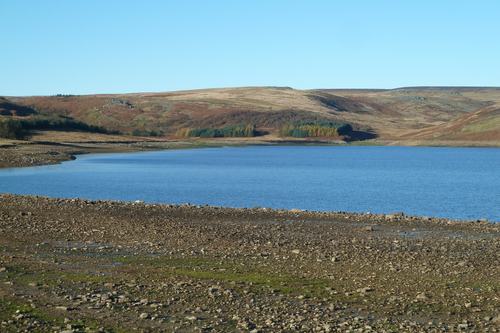
 Low water at Grimwith Reservoir, Yorkshire. Photo: Peter Bond, CC BY-SA 2.0Water company chief executives have briefed the National Drought Group on the steps they are taking to protect customers’ supplies, after severe drought was declared in parts of Cornwall, Devon, Dorset, Somerset, East Sussex and West Sussex.
The government has ordered water companies to monitor reservoir and river levels daily. Measures now in place include releasing less water from reservoirs into rivers, lowering water pressure overnight where appropriate, finding and fixing leaks faster, and moving water around networks to support the lowest reservoirs. Customers’ supplies are not currently interrupted.
The Environment Agency has granted drought permits to South West Water and South East Water for Wimbleball and Ardingly reservoirs, and Wessex Water is preparing seven more applications. The Environment Secretary is considering applications for non-essential use bans from South East Water, South West Water and Southern Water.
According to the Environment Agency, England needs at least 120% of average rainfall over six months to be out of drought by spring.
Water Minister Emma Hardy said it was “encouraging that these efforts are starting to ease the pressure on public supplies”.
Philip Duffy, Chief Executive of the Environment Agency, said: “The rain is welcome, but the drought is far from over.”
John Loynd, Business Manager at the Met Office, said “it remains too early to say whether this will deliver the widespread, sustained rainfall needed”.
Nicci Russell, CEO of Waterwise, said: “Water is scarce in England – and we all need to make sure we waste less, at home and at work.”
Source: Defra and the Environment Agency, 20 October 2026 (original press release on GOV.UK). Contains public sector information licensed under the Open Government Licence v3.0. Photo: Peter Bond, Low water levels at Grimwith Reservoir, via Wikimedia Commons, licensed CC BY-SA 2.0.
